
Photo: Petr Slováček
Struggling to get the engagement you want on Threads?
After analyzing months of Threads data, I’ve identified patterns and strategies that might help you boost your reach and engagements.
I’ve been using Threads (and a few others) almost every day this year, and recently I’ve gotten into the back-end analytics using the API. This has allowed me to look back periodically and see what worked well (or not).
The goal of this post is to share some of the findings I’ve made looking into the data in the hopes that it might help you on your journey with social media.
This post is a continuation of my general tips and tricks for social media, which you can read about here. In the previous post, I kept to more general concepts and overarching themes. In this post, I will get into specifics with examples and the data.
I’d also recommend setting this page as a book-mark, because it’s fairly long with a lot of info. Very likely you’ll want to try to take it in over a few sessions.
Sound interesting? Let’s dive in!
Data Analysis
A preface before we begin: This is primarily using my personal Threads data, but a good deal of these concepts could be applied to other similar platforms like X, BlueSky, Facebook etc. These are also based on my social media habits and niche, but I hope you can learn from it.
Time of Day and Days of Week
Times

Looking into this first visual, we can see that the best times I’ve found to post for both views and engagements (ie, replies, likes, quotes) is as follows in CST:
- 5am – 7am
- 11am – 1pm
- 6pm – 7pm
- 10pm – 11pm
This makes sense based on what people tend to do in North America for phone usages of before work, around lunch, after work, and before bed.
Something to note, as seen by my count of posts by time below, I’ve only posted a few times prior to 6am.

So the spikes in engagement could be related to time or just that I haven’t posted enough within that time period to level out the average.
Think of it like a ‘level of confidence’ meter. The more posts, the more confident. This is a bit of a self-reinforcing number being that as I see patterns I tend to try and post in that space and then can lead to skewing the numbers.
I will also say, now knowing roughly when people tend to be on socials, I don’t think too much about when I post. On average it tends to even out, and without scheduling, I tend to try and post something in the early morning and something before bed.
Days of the week
Where things get interesting, in my opinion, is when we look at the comparison of top average views days vs top average engagement days. When it comes to posting, I tend to post 1-2 times a day and so with these visuals I have a higher confidence in their averages (being that the amount of data within each bar is roughly the same).

In this visual we see that the top three days by views for me has been Wednesday, Friday, and Tuesday. Interestingly though, Wednesday is one of the lower days (almost lowest) as we can see below.

Similar to the question of ‘what time do I post’, I tend to not think about it too much as for when I’ll post on socials. The exception is that I will tend to post big news or announcements on Monday or Tuesday, as this has been the most consistent times for the most views/engagements on average and it aligns with my blog writing pattern.
That being said, if I have news to share, I’d much rather post it when it happens in the same day vs trying to save it for the future. My memory isn’t good enough for that, haha. So better to post when I have the inspiration, than trying to log it for future use and forget about it (there are exceptions to this, but generally how I try to keep it chill).
Content Analysis
Now lets dig into some interesting new findings when it comes to the content itself.
The first thing that stands out to me, as shown below, is that carousel type images tend to do fairly well! This is in contrast to previous analysis where it showed that images tend to not do very well. (though this does vary greatly on the kind of image your posting, as memes and jokes can do very well).
If you’re unfamiliar, I have a few examples in the “Example” section lower down. Essentially these are posts where there is a series of pictures you have to swipe to see the rest.

I’d be curious to know if anyone has found a niche where Audio clips work. Any time I’ve done them they’re near my lowest performing out of all my posts.
A short note on the Video posts is that I have seen some do fairly well with videos, but the differentiator is the content. For example, music + video (musicians) and some artists (art / art process) can do very well. I have yet to find a solid video content style for readers or writers (which is my main niche), TBD!

Finally here, looking at the number of words per post. For the most part, as seen above. For the most part, posts tend to perform around the same regardless of length. I have noticed that formatting your posts in different ways to be clear or add emphasis will help your posts, but for the most part write as much or as little as you want.
The above visual does seem to indicate that it’s better to lean one way or the other (and as a side note, I recommend mixing it up from time to time). Short punchy posts, vs more detailed and thought out posts seem to do well.
Corelating Quantity to Engagements
Something that I’ve seen as a pattern is that it seems that posts on Threads tend to get seen within a few days of posting. The visual below reinforces that it does seem to be the case.

By showing the number of posts and engagements as a rolling 3 day average, we can see a few things:
- The more you post, the more engagements you’ll tend to see. I tend to post once a day, though I have been experimenting with 2-3 times a day. What you post does impact this as well, but if you’re able to post more high quality posts, the data shows that you’ll see a pattern of engagement following.
- Don’t delete posts if in a given day they don’t ‘perform’ well. Posts will potentially be fed to other people up to several days beyond the original date and could then go viral (if that’s what you want).
- If you’re just starting out, it will take some time to ramp up as the rolling window is a lagging thing. This also pertains to if you take a break from socials, don’t be shocked if you come back and your engagements or views are lower than you’re used to seeing. (I still recommend taking socials-breaks, but it’s important to keep in mind).
What Engagements Lead to Viral Posts
This section comes with a pandora’s box type disclaimer. Once you know this, it’s hard to not think about it. If you don’t want to passively think about this in your and other’s posts, maybe skip this one?

Still here? Alright, I’ll share this one. I’ll say I have been a bit hesitant to share this as it could lead to some outcomes that we see in other social platforms where the quality of posts decrease significantly. The key is currently: Replies lead to virality. Or another way of saying it is that if you can encourage people to reply to your post, you will get boosted views. If those views then also feel encouraged to reply, the cycle continues and will do so for a few days (as mentioned above with the rolling window).
Why do I call this the Pandora’s box? On the positive side, it means that if you want to reach more people the way to do so is to inspire people to comment. The negative side is that, right now, the algorithm tends to favor posts that get a lot of comments which has led to some… less than stellar quality posts (ie, engagement farming). This is also why you’ll see posts that are controversial to be viral.
I debated not sharing this bit of info, but I figure it’s better to know and then leave it up to the reader for how they’ll act on the info.
As a test, and to reinforce the concept, I created three posts within minutes of each other. I then tracked their view count over the course of a day to see what led to significant view increases. The short answer is that for every comment, my post had roughly 10-20 more views per unique commenter. This is an important distinction and it makes sense with a bit of thinking.
Every time someone comments on your post, it’ll then be brought up into their follower’s feeds who have similar interests. Likes can do the same, but it seems that currently it’s less so.

“Low View” Posts
Something I’ve seen is that Threads will test posts on a handful of followers. This number tends to vary, though it seems to correlate to your number of followers.
For me that number is around 40 to 60 views that it samples my post with. After that, if a post doesn’t get comments or shares, it’ll stop sharing it.
There does seem to be another threshold where it decides to keep sharing it beyond a day or two, though I haven’t watched closely to see and it’s difficult to say in hindsight because the data isn’t there.
All of this to say, if you have lower view posts, try not to take it too hard!
To Emoji, or Not to Emoji
Short answer: Emoji!
Slightly longer answer: On average, posts that had emojis had 15% more views, 33% more likes and to 45% more replies (as seen below here). 🤯

How you use emojis is also pretty important, just as much as which ones you use. But in general, if you’re making a post, consider throwing an emoji in there that helps draw the eyes or add emphasis to a section. You’ll likely see an increase in the above values over time. (I will note though that some screen readers will read out the full description of the emoji name, like ‘smiling-face-with-three-hearts’. With this in mind, I don’t recommend having too many emojis back to back for those with visual disabilities or using visual accessibility features.)
As for which specifically, this varies greatly. I’ve pulled the data for myself but this would likely depend on a number of things. The general advice here is, consider these emojis like key words. Any time that someone reacts to a post containing that kind of emoji, the algorithm will tend to show you more that have that emoji or have a vibe like it.
For me, because I’m a fantasy author, the dragon emoji is one of my top performing emojis.
Something that I’ve seen in myself and others is that using the Thread emoji (and actually containing a thread) is a powerhouse that can give people a lot of content in one go and they tend to do well.


(if you want to see a bigger version of these, right click or long-press on a phone to open the image in a new tab!)
Keywords (for me)
In the previous post on Threads, I did a smaller analysis on some of these topics. One of the suggestions from a fellow Thriend (Threads friend, @ianthomashealy) asked to also look at the lower performing key words.
This, like the emojis, will be something that will vary for every person and depending on your niche. But in general these are the words that popped up for me.
Higher performing
- book
- writing
- haha
- week
- fantasy
- fellow
- writers
- new
As a bonus, I’ve also seen niche-specific key words do well. So for example, I’ve seen words the following words do well: Tolkien, Lord of the Rings, Rings of Power, Silmarillion, The Hobbit, etc
Lower performing
On the flip side, these are some of the common words that I’ve seen go less far
- challenge
- again
- maybe
- anyone
- question
- think
- need
- advice
- could
- help
I can speculate on the ‘why’ of it, but in general it seems that less confident posts tend to not do as well. Along with asking people for something (help, advice, need, etc). This does vary, but if you think about it most people are out there looking for things for themselves. It’s not a dig against that, just helpful to realize that other people have their own needs, wants, desires. (there’s a whole section of a Dale Carnegie book on this subject, which is work a read if you want to dig deeper).
This being said, I keep to my previous comment that I’d much rather post what I’d like than try to form it to an algorythm. It helps to think about what kinds of things to post and themes that are generally more readily recieved (which I talk about more in my other post. )
Example Content Types
Alrighty, now its time to get into more specifics of the kinds of posts I’ve seen do well. I’ve seen this in others, but I’ll primarily share posts from myself as a showcase.
Hook and Engage
You will likely have fractions of a second to grab someone’s attention. In that time, a person is subconsciously deciding whether or not your post is interesting enough to keep reading.
Having a leading line of a hook is a great tool to grab onto that passive attention and bring it to the more active part of one’s brain.
Once you have their attention, the next step is to try and engage them in the subject as seen below.

Ask a Question with an Emotional Response
Emotions will drive a great deal of engagements. The strongest, in my opionion, tend to be the positive vibes for people (love, joy, happiness for another) and the negative vibes for people (anger, frustration, etc). I don’t personally recommend upsetting a lot of people, because it’ll attract more of that conflict in your life, but it technically is a tool you can use.
This example below has a mix of that. On the surface level, I’m engaging people on their emotional side (what do you feel) but also sneaking in there a bit of controversy to engage the action part of the brain to respond (Romantasy).
To be honest, I didn’t even know this was a thing that would trigger people (and you may run into examples like that), but in this case it was actually a good example and I learned a lot from the comments.

Multi-Thread Posts
Multi-Thread posts can be huge. I’m not able to pull the data as directly, but as seen from the views based on emojis, whenever I make a thread I use the thread emoji (sometimes the down-point). Each of these threads tend to do well on one of the metrics. But not just because of the content type, but because of the story telling.
Combining the above where you’re engaging someone emotionally (void shouting) and hook line to grab attention, I also start the conversation on a multiple point story. In this case, its about sharing some of my initial analysis with the Threads analytics. People can then follow along with the story to finally leading to some point or engagement.
Similar to the Hook and Engage method, the engagement is still there but is after someone has experienced the story you’ve laid out.
I will say though, these types of posts tend to take longer so I would either do your drafting over a period of days or set aside enough time (for me it can be 1-2h honestly).

Power of Emotions and Making it Easy for a Reader
As mentioned above, emotions move people. Often that move leads to actions. A great example of this is posts sharing personal achievements, especially ones that are easy to relate to or evoke a sense of accomplishment. The emotional narrative about personal growth draws viewers in and are easy for a person to respond to it (often with likes, and sometimes with people giving congrats.)

Formatting is important!
At a quick glance, can someone tell what your post is about? Clarity of posts and conciseness of the concepts can be helped along by good formatting. (ask yourself, if someone was quickly reading in 5-10s what would they think).
Personally I’d recommend breaking up long texts into smaller paragraphs and separating paragraphs with spaces so it’s easier to read. Using punctuation and emojis to break it up visually can help too!
Look a the two following posts and see which one you were able to grasp quicker. Imagine your scrolling through a feed of hundreds of other posts.
Post 1)

Post 2)
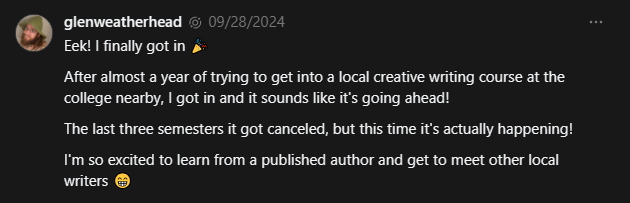
The first post, 6 engagements and 50 views.
The second post, almost 100 engagements and over 500 views.
There’s more to it than just the formatting, but I’ve seen posts of others perform similarly. When formatted well, a person can quickly grasp what the subject is and get drawn into your story. Formatted in a large block of text and people will tend to tune you out because it’s hard to grab onto any one thing.
The Combo Powerhouse: Carousel + Trending Topic
This one is a new one for me, but is something I’ve seen people with very little followers get tens of thousands of views and engagements.
The concept is combining two things that work well into one: Taking carousel posts (which tend to do well) and combining it with key words that work well (in this context, Lord of the Rings).
The below post also incorporates a strong Hook that’s short and easy to understand, and an engagement piece.
In one day, the post almost cracked 2k views.

Tags in OP Tend to Tank
On the flip side, the next few things are things I’ve seen that don’t tend to do well.
The first of which is tagging people in the OP (original post). I personally wonder if this is a Threads being intentional thing, where it prevents people from spamming people to get views. The way to get past this is to tag the person in question in a reply to your post. This way, your OP isn’t tanked, and if the tagged person responds it’ll then boost it further.

Quotes Help, Just Not for you
This is a mixed bag. I’ve seen some quotes do well, but usually it’s when it’s controversial. Supportive quotes unfortunately don’t do that well for you as a poster showing support. I will say though, that it does help the original poster in the current way Threads is set up. (This can be seen by the engagements to the OP that will come through your activity feed as they engage with the OP).
All to say, keep doing this kind of thing because it helps other people out but don’t be surprised when the views/engagements are lower.

Context Switching is Hard
Especially on Threads, I’ve found it’s hard to break into a totally new niche if you’ve been posting/following/engaging with a specific kind for a while. It’s not impossible, so if you want to branch out definitively go for it. I will say though that you may see lower than normal numbers because your followers and the content you follow is different than what you’re posting.
For example, if I mention playing music or doing art on my writer Threads account, the posts will tend to not do as well. Most of my Fellowers (fellow creatives and followers) tend to expect a certain kind of vibe or theme or topic, so when I switch they may not like it as much (or from the algorithm perspective may not even see it because it doesn’t contain similar words to their interests)
Closing Thoughts
If you made it to the end, props to you! That’s quite the read eh? haha.
I hope you found the above helpful. From the feedback I got from the first post of this kind, I saw a ton of people letting me know how helpful it was. Not to doot my own horn, but just to say that because it’s something that people have said is helpful, I don’t mind doing it. My goal is to help as many people as I can, and this seems to be a subject a lot of people struggle with. So maybe with my few (haha, not so few) words I can help someone out a little with what worked for me.
One request, consider sharing this post. As much as I have learned ways to improve my reach with social media, one of the most powerful tools at your hands is the ability to boost other people’s work. (maybe I’ll write up a post at some point of some of the most helpful things when looking to help others 🤔 )
I know there are people who would benefit from reading this, and I do my part to try and share this info. But I can only go so far on my own. Thank you, if you choose to share this with your networks. You are truly helping people more than you know!
As a final note, If you like this kind of post, I’ve enabled category specific subscribing. So if you only want, you can choose to get posts like these that are around how to do social media well emailed directly to you. You can subscribe to all, and also get emails for my encouragement and motivational posts for creatives or my short story and flash fictions.
And as always, stay creative!
– Glen Weatherhad








 Creative Writing Wizard
Leave a reply to Glen W Cancel reply